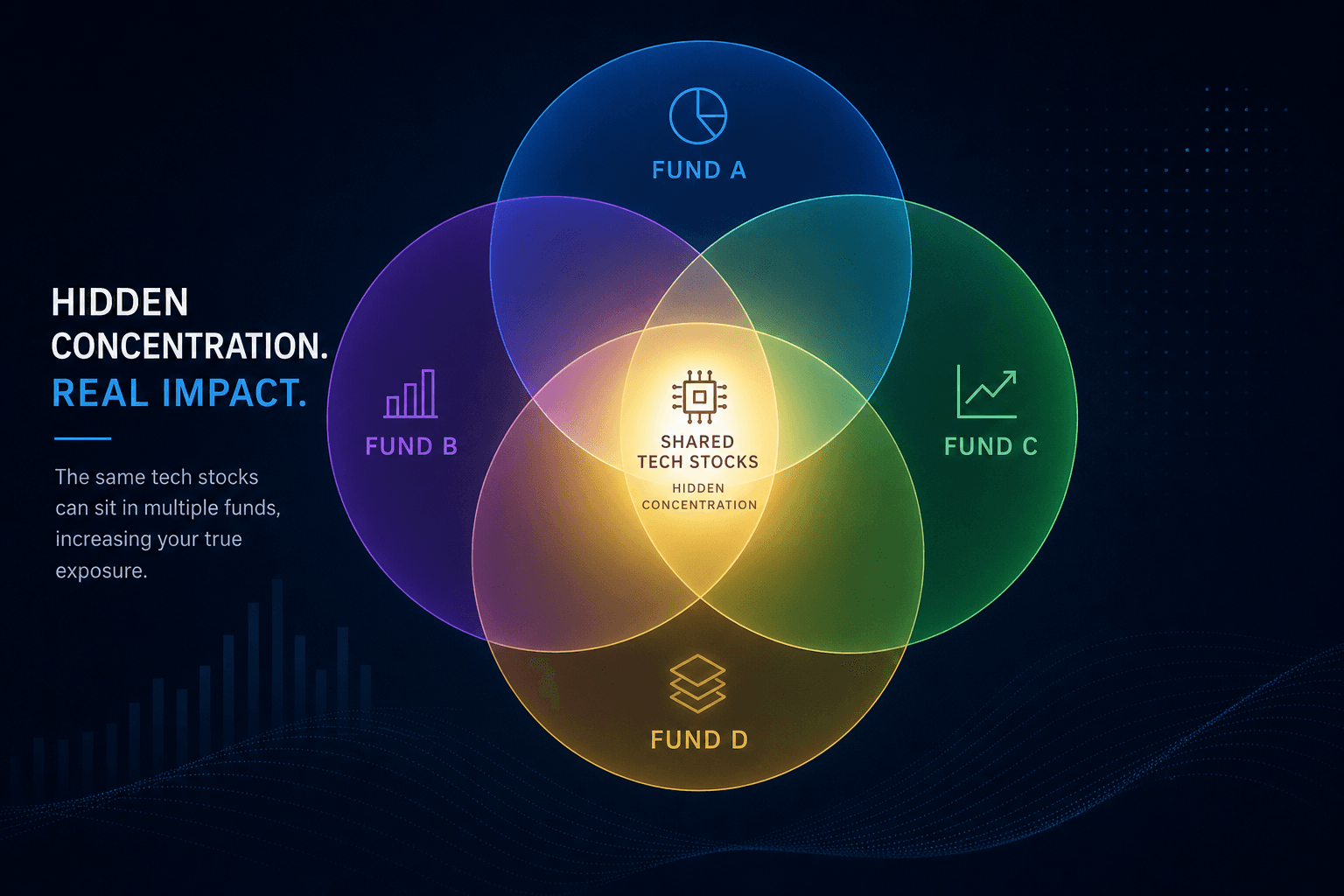
You Probably Have a Lot More Tech Exposure Than You Think
When you own four 'diversified' funds, the same stocks appear in all of them. Here's how to see your true sector exposure - and why the number is almost always a surprise.
Written in house: drafted with AI tools, edited by Melroy, on topics he chose.
A few years ago, I was confident I had a diversified portfolio.
I owned VTI (total US market), VXUS (international), QQQ (Nasdaq 100), and a large-cap growth fund in my 401(k). Four different funds. Four different tickers. Surely that counted as diversification.
Then I actually looked at what they owned.
Apple appeared in all four. Microsoft appeared in all four. NVIDIA appeared in three of the four. The large-cap growth fund's top ten holdings were almost identical to QQQ's top ten. My "diversified" portfolio was, in practice, a concentrated tech bet with some international stocks attached to it.
This is not unusual. It's one of the least-discussed problems in retail investing.
Why funds overlap more than you think
The S&P 500 is market-cap weighted. This means the biggest companies - Apple, Microsoft, NVIDIA, Amazon, Google, Meta - have the largest weight in any fund that tracks it. That's VTI, VOO, FXAIX, SPY, and hundreds of other funds.
Any fund benchmarked to the S&P 500, or to the Russell 1000, or to the Nasdaq, or to any large-cap growth index, will own disproportionate amounts of the same handful of companies.
When you own three different "diversified" large-cap funds, you're mostly just buying the same top-twenty stocks three times.
The fund look-through problem
Your brokerage shows you what you own at the fund level: "You own 400 shares of VTI." It doesn't show you that VTI is 35% tech, 13% healthcare, and has Apple as its largest holding at 6.5% of the fund.
To see your true exposure, you'd have to:
- Look up each fund's sector breakdown
- Multiply each sector weight by the fund's weight in your portfolio
- Sum across all funds to get your total sector exposure
Most people don't do this. It's tedious. The tools for it aren't great.
This is what Prismfolio's fund look-through is designed to solve.
What fund look-through shows you
When the extension reads your positions page, it pulls the sector classification for each holding - and for funds, it looks through to the underlying holdings to calculate your true exposure.
The result is a single sector breakdown across your entire portfolio, not a series of per-fund breakdowns you have to mentally combine.
It also shows you:
- True stock-level exposure - the five or ten individual companies you're most exposed to across all your funds
- Overlap detection - funds that hold substantially the same stocks, so you can see where you're effectively doubling up
- Missing pieces - sectors where your portfolio has significantly less exposure than the market, which may or may not be intentional
What to do with this information
The answer isn't necessarily to reduce tech exposure. Maybe you have a view that tech outperforms and you're comfortable with the concentration. That's a valid position.
But it should be a position you hold deliberately, not one you stumbled into because you bought four "diversified" funds without knowing what was inside them.
A few scenarios where this matters:
You're approaching retirement. Sequence-of-returns risk is real. A 2022-style tech correction at the wrong moment can permanently impair a retirement portfolio. Knowing you're 45% tech before you need to start drawing down is different from discovering it after the fact.
You have employer stock. Many people have both their salary and their savings concentrated in the same company or sector. The sector analysis shows this clearly.
You're adding new money. If you're deciding between adding to your existing holdings or opening a position in a new fund, seeing your current sector exposure helps you understand what you're actually adding to.
The thing nobody tells you
The diversification problem isn't a failure of discipline. The funds are technically different. The tickers are different. The marketing materials say "broad market exposure."
The stocks inside them are just a lot of the same.
Seeing through that is what fund look-through is for.
Install the extension to see your portfolio's true sector exposure →
For research and context only - not investment advice. Sector concentrations are one data point; they should inform your thinking, not drive it in isolation.