How to Find the Hidden Fees in Your 401(k) and Brokerage Accounts
Most investors know their expense ratios. Almost nobody knows their 30-year dollar cost. Here's how to find it - and why the number is almost always larger than you expect.
Here is a question most investors cannot answer: How many dollars did you pay in fund fees last year?
Not the percentage. The dollars.
If you know your expense ratio is 0.75%, and you have $200,000 in your 401(k), you might estimate $1,500. That's close. But it's not the number that matters.
The number that matters is how much that $1,500 would have grown to if it had stayed in your portfolio and compounded at 7% per year for the next 30 years.
The answer: $11,419 - from a single year's fee drag, if compounded.
Multiply that across 30 years of fees, and you're not looking at a small line item. You're looking at a six-figure wealth transfer from your retirement account to your fund company.
Why the percentage lies to you
Fund fees are expressed as percentages because percentages feel small. 0.75% sounds inconsequential. It's three-quarters of one percent. So what?
But fee drag works differently from a one-time cost. It's taken every year, on your total balance - including your gains. As your balance grows, the dollar amount of the fee grows with it. As the fee takes money out, that money can no longer compound. The effect is cumulative in a way that the percentage figure completely conceals.
The industry knows this. That's why fees are almost universally expressed as percentages.
The four places fees hide
1. Expense ratios - the fund's annual operating cost, expressed as a percentage of assets. This is the most commonly cited fee, and the one most investors know to look for. An index fund might charge 0.03%. An actively managed fund might charge 0.75% to 1.20%. A target-date fund inside your 401(k) might charge 0.10% to 0.75% depending on the provider.
2. Fund-of-funds layering - when you own a mutual fund that itself invests in other mutual funds, you're paying fees at both levels. The fund's stated expense ratio only tells you the top layer. The underlying fund fees are often not shown on the positions page.
3. 12b-1 fees - marketing and distribution fees embedded inside some mutual funds, typically 0.25% to 1.00%. These appear in the fund's prospectus but rarely on brokerage statements. They are essentially a fee you pay to help the fund company advertise the fund to other investors.
4. Transaction costs - brokerage commissions have largely gone to zero, but some 401(k) plans still charge per-trade fees or redemption fees. Read your plan document.
How to find your actual fees
On a brokerage account: Navigate to your positions page on Fidelity, Schwab, or Vanguard. For each fund holding, look up the expense ratio (usually visible in the fund details or by searching the ticker). Multiply each expense ratio by the position value to get the annual fee in dollars.
Or: install the Prismfolio extension, click the icon on your positions page, and it will pull the expense ratio for each holding and calculate the total annual fee in dollars - plus the 10 and 30-year compound cost.
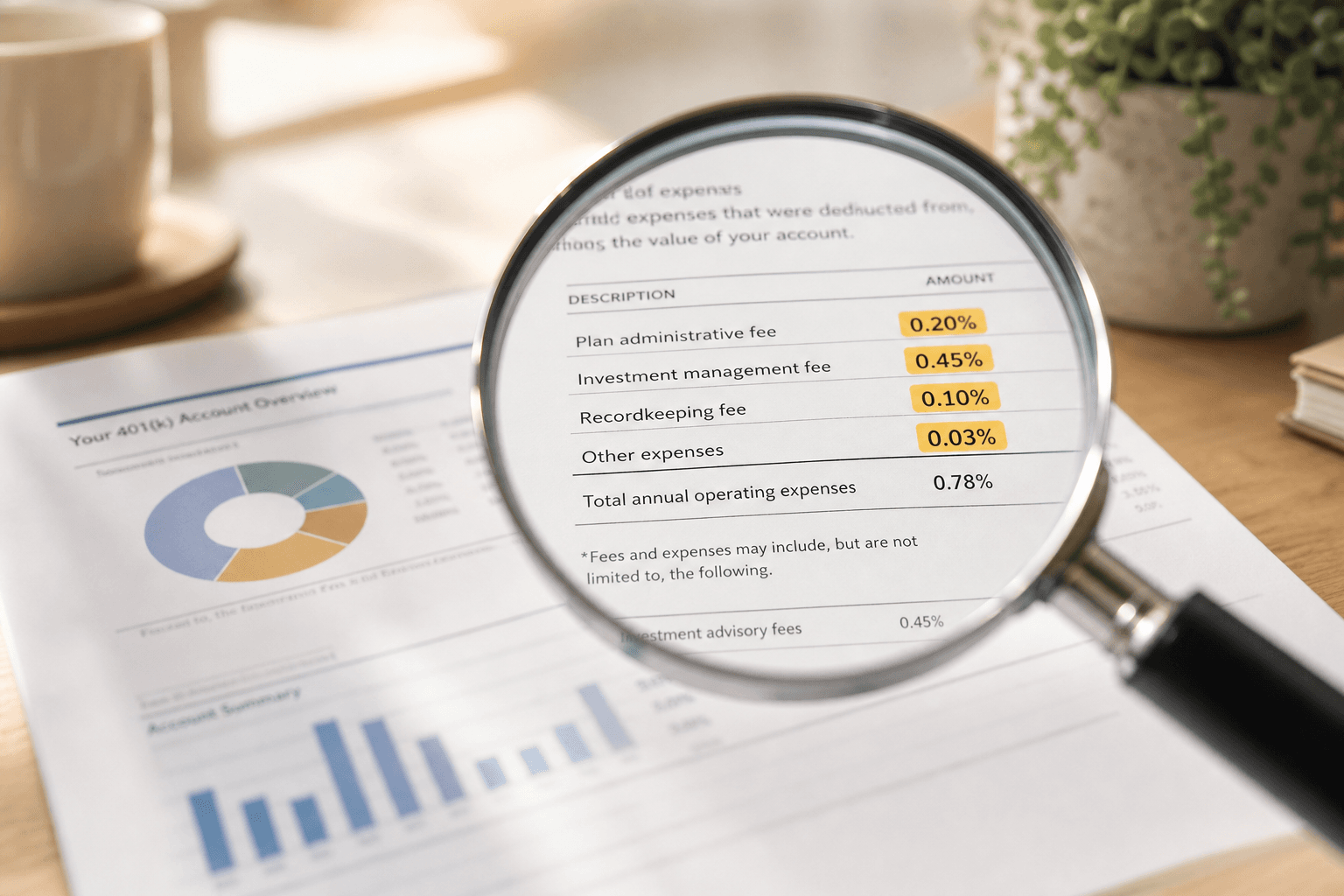
On a 401(k): Download your plan's annual fee disclosure document (plans are required to provide this). Look for the "total annual operating expenses" for each fund option you're in. If you can't find it, ask your HR department or search "[Your Plan Provider] 401k fee disclosure."
The calculation: For each holding, multiply the position value by the expense ratio. Sum those up for your total annual fee in dollars. Then go to our fee calculator, enter your total balance and the blended expense ratio, and see the 30-year compound cost.
What "good" looks like
For comparison:
- Total US market index fund (e.g. VTI, FSKAX): 0.03% - $60/year on $200K, ~$7,000 lost over 30 years
- S&P 500 index fund (e.g. VOO, FXAIX): 0.03% - same
- Target-date fund, Vanguard: 0.08–0.15% - $160–$300/year on $200K
- Target-date fund, average employer plan: 0.25–0.75% - $500–$1,500/year on $200K
- Actively managed large-cap fund: 0.65–1.20% - $1,300–$2,400/year on $200K
- Fund of funds (common in small business 401(k)s): 0.75–1.50% - often disclosed misleadingly
The spread between 0.03% and 0.75% over 30 years on a $200K starting balance is roughly $130,000 in forfeited wealth - even if neither fund outperforms the other.
The one number to focus on
Stop thinking about expense ratios as percentages. Find your annual fee in dollars. Then put it in a compound interest calculator and see what it would have been worth in 30 years at 7%.
That's the number your fund company doesn't put on your statement.
Calculate your 30-year fee cost →
For research and context only - not investment advice. Past fee drag doesn't predict future performance, but fees are one of the few investment factors you can control directly.